
Practical AI · AI for Small Businesses · Business Operations
Before AI Can Help Your Business, It Needs to Understand Your Business
Five questions to help you get started.
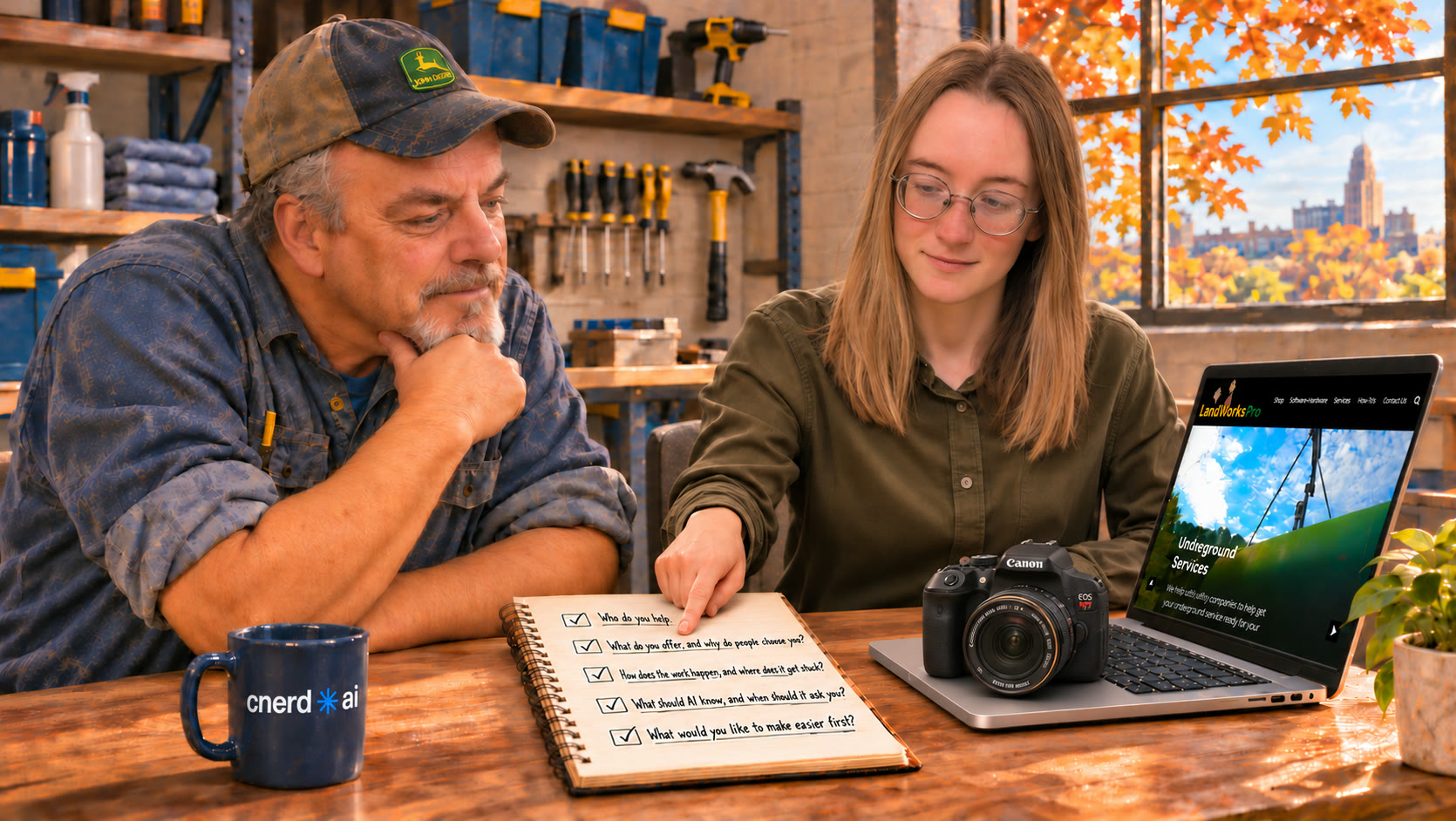
If you and I sat down to talk about using AI in your business, I’d start by asking you about the work.
Who calls you? What do they need? What information do you keep asking for? Where do things get held up?
You probably have those answers. You work with them every day. But a lot of that knowledge lives in your head, in conversations with employees, or in notes scattered around the office.
AI needs you to explain it.
You can type “Help me market my business” and get a professional-sounding answer. The trouble is, it may sound like every other business in town.
As I’ve been building onboarding tools through CNERD AI, I’ve been working on ways to get that everyday knowledge into a useful form. It starts with giving the owner room to explain the business in their own words.
You don’t need a polished business plan. Start with these five questions.
1. Who do you help, and what do they need?
Think about what’s happening when someone contacts you.
An auto shop might say, “Our customers need their vehicles for work and family. They want to understand what’s wrong, what needs attention, and what happens next.”
An apparel business might say, “We help local organizations order shirts. They often need help choosing the garment, collecting sizes, and getting their artwork ready.”
That gives AI a clearer picture of the customer and the job.
Finish this sentence: “People usually come to us when ______, and we help them ______.”
2. What do you offer, and why do people choose you?
Tell me what you actually do. Include the details and limits a customer should understand.
For example, a contractor might explain: “We repair gravel driveways. Before recommending work, we look at the surface, drainage, and how the driveway is being used.”
Then tell me what customers appreciate about working with you. If you say “good service,” explain what that looks like. Do you photograph the problem? Explain the options? Keep the customer updated?
Specific details give AI something useful to work with. Check that they describe practices your business actually follows.
Finish this sentence: “We provide ______, and customers choose us because we ______.”
3. How does the work happen, and where does it get stuck?
Walk me through a typical job, from the first call to completion.
Who collects the details? Who prepares the estimate? What needs approval? How does the crew get the information?
Imagine a shirt order where the quantity comes by email, the sizes arrive by text, and the artwork is somewhere in a Facebook conversation. Someone has to pull it together before the order can move forward.
A simple intake form could help collect those details. AI could help organize the answers and draft a follow-up for anything missing.
Finish this sentence: “Our usual steps are ______. We spend too much time chasing ______.”
4. What should AI know, and when should it ask you?
Think about what you would explain to a new employee.
They need accurate service information, your process, and examples of how you talk with customers. They also need to know when a decision belongs to you.
AI might draft a reply explaining how to request an estimate. Someone in your business should check before it promises a price or a completion date.
Start with information appropriate for the tool you’re using. You can use fictional customer details while trying things out.
Finish this sentence: “AI can work from these confirmed facts: ______. It needs to ask us before ______.”
5. What would you like to make easier first?
Pick something you can try and check.
Maybe estimates keep getting delayed because information is missing. Maybe meeting notes never become assigned tasks. Maybe customers keep calling with a question your website could answer.
For the shirt-order example, try a draft intake form with a few sample orders. Does it collect the right details? Would a customer understand it? What did we miss?
Those answers help you decide whether to keep improving it.
Finish this sentence: “We want to make ______ easier. We’ll know it helped when ______.”
Once you’ve answered those questions, take a look at your website.
Does it tell the same story?
You might want more commercial work while your website mostly shows residential projects. You might offer a useful service that barely gets mentioned. A customer can only work with the information they can find.
Your answers can help you spot those gaps.
You can also paste them into an AI tool and try this:
PROMPT
Try it with your five answers
Using these answers, write a plain-language description of my business. Explain who we help, what we offer, and how the work happens. Flag anything unclear and ask up to three follow-up questions. Suggest one small task AI could help with and explain what I should check. Use only the facts I provide. Do not invent prices, availability, credentials, or promises.

[Paste your answers.]
Read what comes back. Correct it. Make sure it sounds like you and describes the way your business works.
That gives you a starting point you can reuse and improve.
You bring the experience. I can help you work through the technology. Together, we can find a useful place to start.
If you’re in Olean, Allegany, or the surrounding Western New York communities, bring me one task that keeps slowing things down. Let’s talk through it.